Feature article
What happened?
OpenAI's June 25, 2026 research post on Codex gives a useful name to something a lot of AI operators already feel: the workday is starting to split into parallel lanes. One person still has one calendar. But if that person can brief, run, and review several agents at once, the amount of machine-executed work moving through the day can exceed the hours available to the human.
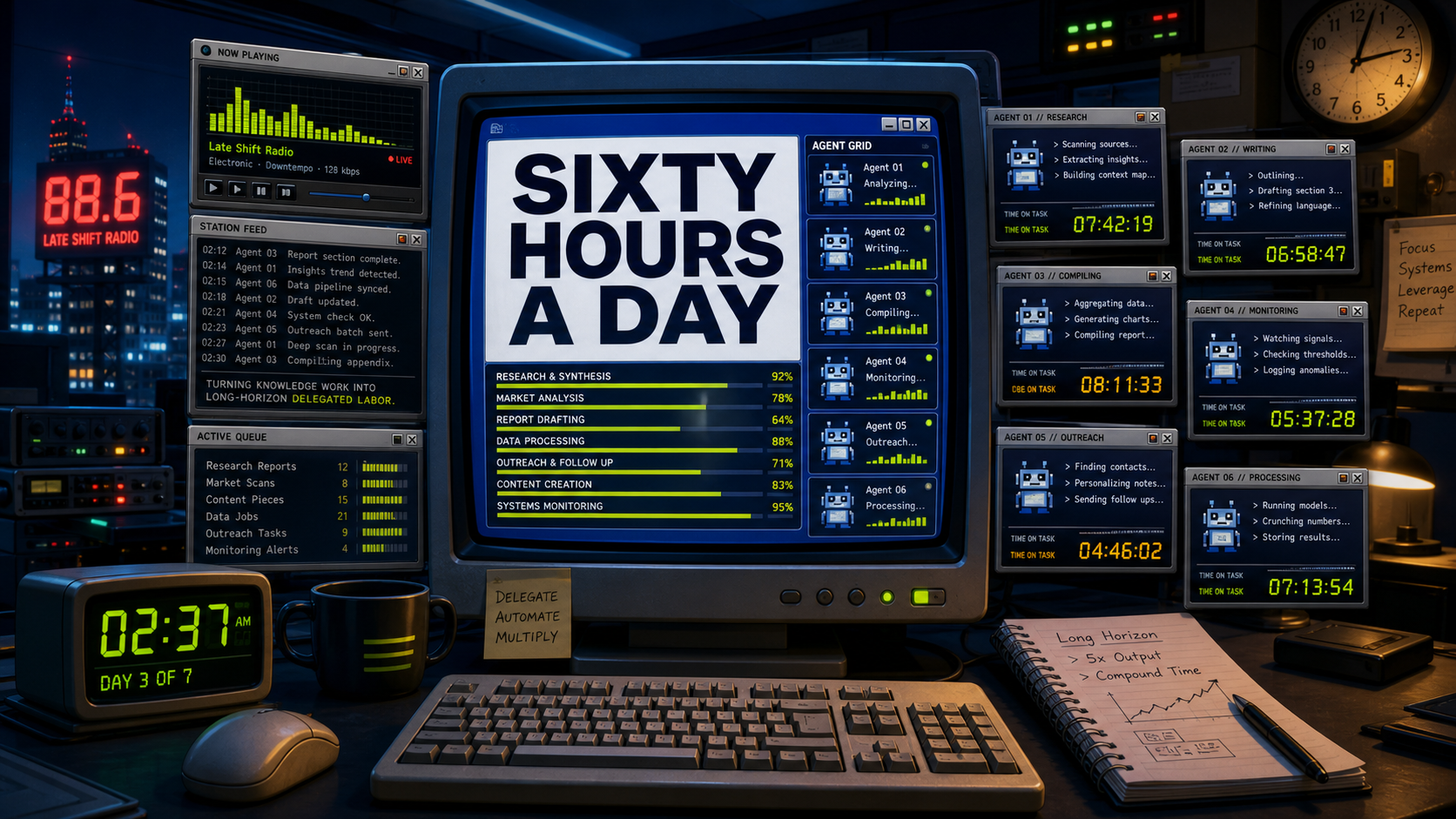
The cleanest number is the one that became the hook for Sixty Hours A Day: by June 2026, OpenAI said users at the 99th percentile inside the company were generating more than 60 hours of Codex agent turns per day, spread across multiple parallel agents.
That is not a promise that everyone gets 60 productive hours. It is not a call for people to work more. It is a measurement of a new operating pattern: the human becomes less like a single task-doer and more like the person running a small desk of delegated work.
The numbers that matter
OpenAI's research describes agentic AI as a shift from single interactions to delegated, long-horizon tasks. That matters because it separates agents from ordinary chatbot use. A chatbot answer can be helpful, but it usually lives inside one short exchange. An agent can run for minutes or hours, use tools, inspect files, iterate, and return with work that would have taken a person much longer to produce.
The Codex adoption data makes that shift concrete. By May 2026, OpenAI reported that 80.6% of sampled individual Codex users had made at least one request estimated to exceed 30 minutes of human work. 70.2% had made at least one request estimated to exceed one hour. 25.6% had made at least one request estimated to exceed eight hours.
Those thresholds are the real story. The jump from a five-minute prompt to a one-hour delegated task changes the user's job. The user is no longer only asking for an answer. The user is assigning work, waiting for progress, judging evidence, and deciding whether the result is useful enough to ship.
The workday becomes a control board
The old knowledge-work model was mostly sequential: read, decide, write, revise, send. Agentic work makes the day feel more like a control board. One task can be researching. Another can be drafting. Another can be checking a spreadsheet. Another can be preparing a code patch or turning notes into a brief.
That sounds like leverage, and it is. But it also moves the bottleneck. The scarce resource becomes judgment. The operator has to know what to delegate, how to brief it, what proof is required, and when to stop a task that is moving but not creating value.
This is where a lot of AI optimism gets sloppy. Running more agents is not the same thing as doing better work. A vague instruction can create a vague result faster. A weak review process can turn confident nonsense into a published mistake. A team that rewards volume without evidence will get more output and less trust.
The best version of the 60-hour workday is not a person doing more hours. It is a person managing more bounded work streams with clearer standards.
Why non-developers matter
Codex started as a software engineering agent, but OpenAI's research says the adoption curve moved beyond engineers. The company reported especially fast growth among non-developer users: 137 times growth for individual non-developer users since August 2025, 189 times growth for organizational non-developer users, and 12 times growth among non-developer users inside OpenAI.
That is the part companies should pay attention to. If agentic tools only made engineers faster, the story would still be important. But the bigger shift is that people outside engineering can start to do adjacent technical work: automation, data transformation, structured analysis, debugging, internal tooling, and workflow cleanup.
This does not turn every recruiter, lawyer, marketer, publisher, or operator into a software engineer. It changes the boundary around what they can attempt. The non-developer who can brief an agent well, check its work, and use the result safely gets access to a wider range of execution.
What managers should learn
The management lesson is blunt: agentic work rewards clear delegation and punishes fuzzy thinking.
A useful manager of agents has to do four things well. First, define the outcome in plain language. Second, break the work into tasks small enough to inspect. Third, name the evidence that would prove the task is done. Fourth, decide what still needs human taste, context, or accountability.
That is why the phrase "AI skills" is too small. Prompting is one piece. The bigger skill is operating a system where humans set intent, agents run bounded work, and proof determines what gets accepted.
Microsoft's 2026 Work Trend Index makes a similar point from the organization side: as agents take on more execution, companies have to redesign how work is assigned, measured, and learned from. McKinsey makes the same practical point in different language, describing agents as virtual coworkers whose value depends on workflow design, roles, and oversight.
What can go wrong
The 60-hour workday can become a mess if people treat the number as a flex instead of a warning label.
More agent runtime can mean more useful work. It can also mean more half-finished drafts, more unreviewed claims, more duplicated effort, and more convincing mistakes. The system only gets better when the review loop gets better.
There is also a social problem. If leaders misunderstand agentic work, they may start expecting impossible output from people without giving them better systems. A healthy agent workflow should reduce busywork and increase leverage. A bad one just creates pressure with better dashboards.
The right takeaway is not "make everyone run more agents." The right takeaway is "teach people to delegate, verify, and decide."
Why this became a song
Sixty Hours A Day turns the research into a feeling. The song is not trying to explain every chart in the OpenAI post. It captures the moment an operator wakes up, checks the screens, and realizes the old calendar is no longer a good description of the work.
That is why the hook works. "I got sixty hours running in a twenty-four-hour day" is not a productivity boast. It is the weird little truth of agentic work: some of the work keeps moving after the human steps away.
The song belongs next to the article because the two jobs are different. The article is for search, citation, and explanation. The song is for memory. A good media system should be able to do both.
What operators should do now
The practical move is to build a small agent desk before building a huge automation dream. Pick one recurring workflow with clear inputs, clear outputs, and a review step. Then split it into delegated lanes.
For a media operator, that might be source research, article outline, citation extraction, metadata, thumbnail direction, and publish checklist. For a business team, it might be weekly reporting, data cleanup, internal docs, sales research, or QA. For a founder, it might be bug investigation, customer-note synthesis, and launch-page revisions.
The pattern is the same: do not ask the agent to "handle the project." Ask it to move one bounded piece of work, then show evidence.
The companies that win will not be the ones with the longest agent runtime. They will be the ones with the clearest delegation, the fastest review loops, and the best taste about what deserves to be shipped.
Sources
- OpenAI, How agents are transforming work, June 25, 2026.
- OpenAI, Introducing Codex, May 16, 2025.
- OpenAI, Harness engineering: leveraging Codex in an agent-first world.
- Microsoft WorkLab, Agents, human agency, and the opportunity for every organization, May 5, 2026.
- McKinsey Global Institute, AI: Work partnerships between people, agents, and robots.
- Suno, Suno, the music generation platform used for this Model FM drop.