Feature article
What happened?
OpenAI wants businesses to stop asking how cheap an AI model looks and start asking how much finished work it produces.
On July 17, OpenAI CFO Sarah Friar published a scorecard for the AI age. Its proposed north-star metric is “useful intelligence per dollar,” built from four questions: Did the AI complete work that matters? What did each successful task cost? Could people depend on the result? Did the economics improve as usage grew?
That sounds obvious. It is also a meaningful correction to the way AI is often bought and discussed. Seats, active users, token prices, and benchmark scores are easy to count. None proves that a customer issue was resolved, a code change passed its tests, or a contract was reviewed accurately and on time.
The hook
The company selling the meter is telling buyers to stop staring at the meter.
OpenAI argues that a cheap token can produce expensive work. If a lower-priced model needs repeated attempts, longer waits, or more human review, its final cost may exceed that of a stronger model that succeeds once. Friar's framework therefore counts the entire task: AI usage, compute, employee time, corrections, retries, and rework.
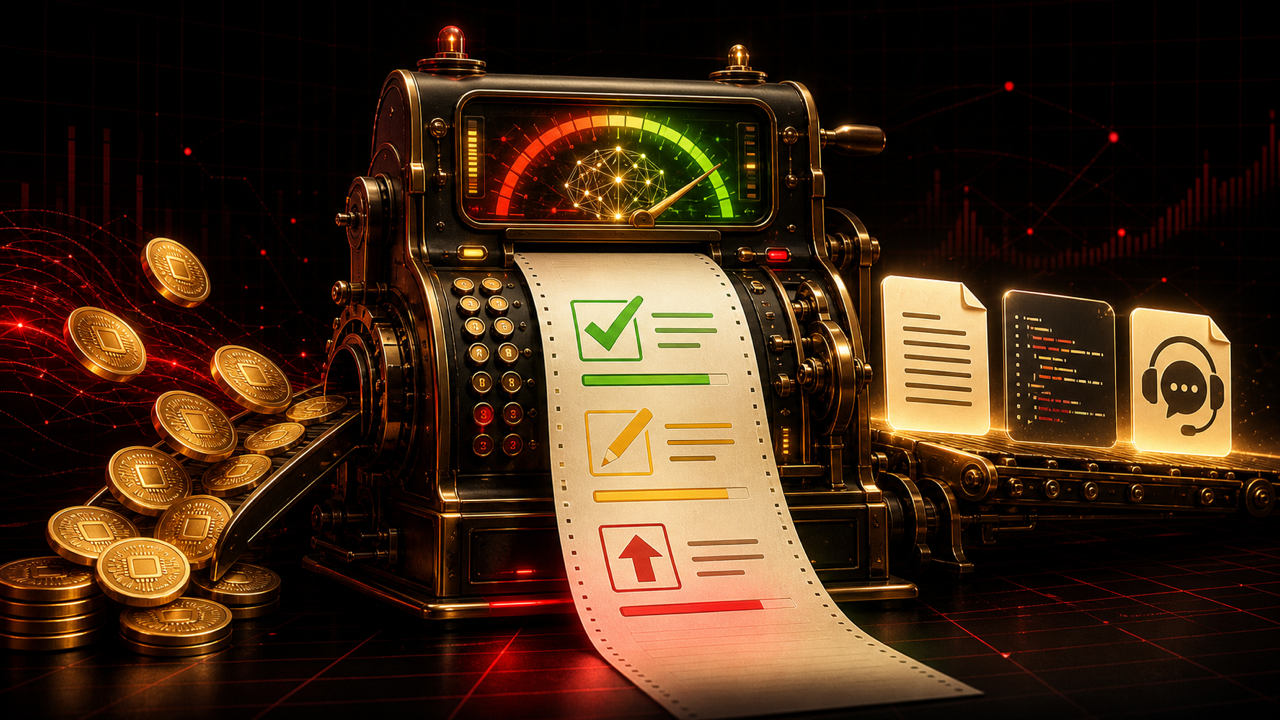
The sharpest part is the dependability test. OpenAI recommends sorting outcomes into three plain buckets: ready to use, needs correction, or needs escalation. That language turns reliability from an abstract benchmark into labor. Every correction and escalation is a person re-entering the loop.
Axios noted the commercial tension. OpenAI benefits when buyers focus on total value instead of the sticker price of its premium models. Meanwhile, some companies are routing routine tasks to cheaper systems and reserving frontier models for harder work. Those positions are not opposites. A real scorecard can reveal where premium capability earns its price and where it does not.
Why this became a song
“Worth Every Token” is sung by the person who has to reconcile the glowing AI dashboard with the work still sitting unfinished.
The chorus does not reject expensive models or celebrate cheap ones. It asks each system to earn its place: show what passed, show what worked, and include the human rescue cost. The hook makes the buyer, not the vendor, the judge of success.
That is why the track moves like an upbeat money protest instead of a spreadsheet lecture. The argument is simple enough to sing: if you want the dollar, show me the work.
What operators should do now
Choose one repeated workflow and define “done” in the system where the outcome happens. A support bot is not successful because it generated a response. It is successful when the issue is resolved at the required quality level. A coding agent is not successful because it wrote a patch. It is successful when the change passes review and tests.
Then record the full cost per successful result. Include model usage, orchestration, latency, employee review, corrections, escalations, and failed attempts. Track the three dependability buckets over time. If ready-to-use work rises while cost holds or falls, the system is improving.
Finally, route by evidence. Use the least expensive model that consistently clears the workflow's quality bar, and move up when stronger reasoning reduces total cost. Do not standardize on a premium model because its vendor says value matters. Do not standardize on the cheapest model because its token price looks tidy. Let completed work decide.
Why It Matters
AI is moving from experimentation into budgets that must defend themselves. “Useful intelligence per dollar” is useful only when customers own the definition of useful, measure human rework honestly, and keep the right to route each task to the system that earns it.
Sources