Feature article
What happened?
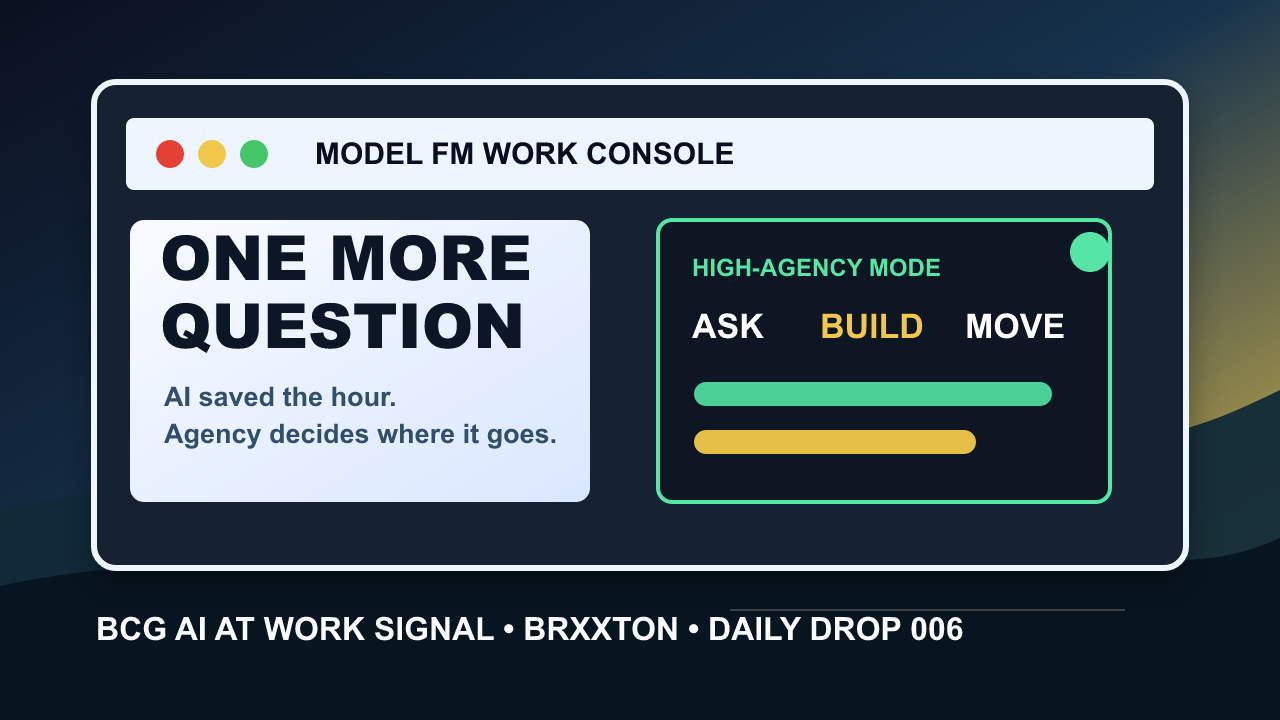
Business Insider published a useful AI-work signal on June 26, 2026: BCG's Julia Dhar says the workers pulling ahead in the AI era are not just the ones with tool access. They are the ones with a high-agency mindset. They ask for clarity, move before the instruction manual arrives, solve recurring problems, and use feedback to sharpen their instincts.
That sounds like consultant language until you put it next to BCG's own 2026 AI at Work research. BCG says frontline AI adoption has surged, a large share of regular users are saving serious time, and many employees now spend more of the job managing or directing AI than doing the old work by hand. The weird part is that the saved time does not automatically become value. If nobody tells the worker what to do with the reclaimed day, it can leak away into busyness, meetings, inbox cleanup, or vague anxiety.
That is why this became a Model FM drop. The AI labor story is usually framed as replacement or productivity. This signal is more interesting because it points at the new character who survives the transition: the person who sees the open space and moves. Not the loudest person in the room. Not the person who memorized every tool name. The one who asks one more question.
The hook
The sharpest line in the Business Insider piece is Dhar's description of the person "asking one more question" or doing a little more than the natural baseline. In the AI era, that extra move matters because the baseline is changing under everybody's feet.
BCG's report says 42% of regular AI-using frontline employees report saving eight hours a week. That is a full workday. BCG also says 74% of frontline employees are now regular AI users, up 23 percentage points from 2025. The press release adds the harder management problem: 66% of regular frontline AI users get limited or no guidance on what to do with the time AI saves.
Put those numbers together and the hook gets obvious. A company can hand everybody AI access and still fail to create value. A worker can save a day and still not know what changed about the job. A manager can watch the whole team move faster and still not redesign the work. The high-agency person is the one who treats that confusion as a place to build.
The song turns that into a bright country-trap anthem because this is not only a fear story. There is anxiety in it, but there is also momentum. The worker in the song is not waiting around for a perfect roadmap. They are watching the bottleneck, naming the missing handoff, building the small fix, and asking the next question while the rest of the office debates whether the tool is approved.
Why this became a song
The song's character is the worker who can feel the job becoming stranger and decides not to freeze. They have a dashboard open, an AI assistant running, a messy process in front of them, and a manager who may not have the answer yet. Instead of treating that ambiguity as permission to hide, they turn it into a beat.
That is pure Model FM material because the cultural shift is bigger than a software feature. AI is changing what counts as initiative. In a pre-AI office, doing a little extra might mean staying late, formatting the deck, or answering emails faster. In an AI-shaped office, doing a little extra can mean turning a repeated frustration into a lightweight workflow, interviewing the customer before the product meeting, or testing whether an agent can clear the first draft before the team wakes up.
The chorus promise is simple: one more question opens one more door. The phrase is small enough to sing, but it carries the full operator lesson. The workers who wait for perfect clarity may be waiting a long time. The workers who create clarity through action get more chances to matter.
This is also why brxxton fits. The story needs motion, swagger, and a little protest energy, but it should not sound doom-heavy. The point is not "AI is coming for everyone." The point is "the job is getting remixed, and the people with agency have a head start."
Why It Matters
The value of this signal is that it moves the AI-work conversation away from tool theater. A company can have premium AI seats, internal launch meetings, and a pile of usage charts while still missing the harder question: who is turning the time savings into better work?
That matters because the human job is not disappearing in one clean motion. It is being split into judgment, direction, verification, taste, customer understanding, and process repair. Those are not passive skills. They reward the person who notices the gap and brings a practical next move.
The high-agency worker is not magical. They are just earlier to the useful question. What keeps breaking? What can the AI draft? What needs a human check? What customer signal are we ignoring? Where should the saved hour go?
What operators should do now
For operators, the lesson is practical. Do not measure AI adoption by whether people have accounts or whether usage is high. Measure whether saved time is being turned into better outcomes. If AI frees eight hours, somebody needs to decide where those hours go.
Start with the recurring problems. Look for the handoff that breaks every week, the report nobody trusts, the customer question that keeps appearing, the internal process that only one person understands, or the decision that waits too long because the first draft is annoying. Those are better AI opportunities than generic "be more productive" advice.
Then give the team permission to bring fixes, not just concerns. A high-agency employee should be able to say, "I noticed this keeps happening, I made a rough version of a tool, here is what it saves, here is where I need feedback." That is a different management rhythm from waiting for a full transformation program.
The uncomfortable part is that this raises the bar for individual contributors. As AI agents enter everyday workflows, more people are going to manage small systems before they have formal management titles. They will direct AI, check output, choose what matters, and decide when a saved hour becomes a better customer experience rather than just a shorter task list.
That is the real AI culture signal. The future-of-work winner is not only the technical expert. It is the person who can operate in ambiguity, stay optimistic without being naive, and keep turning open questions into visible value.
Sources